

 All news is rigorously fact-checked and reviewed by leading blockchain experts and seasoned industry insiders.
Litecoin is a peer-to-peer digital currency that lets you send value worldwide in minutes with low fees on an open, public blockchain.
At a glance
- Ticker: LTC
- Launched: 2011
- Block time: ~2.5 minutes
- Maximum supply: 84,000,000 LTC
- Consensus: Proof-of-Work (Scrypt algorithm)
- Typical use: Everyday payments, remittances, transfers between exchanges and wallets
Table of Contents
- Litecoin in a Nutshell: Key Facts
- From 2011 to 2025: The Story of Litecoin
- How Litecoin Works Under the Hood
- Litecoin vs. Bitcoin: Digital Silver Meets Digital Gold
- Use Cases in 2025: From Payments to Gaming
- How to Buy and Store Litecoin Safely
- Beginner’s Checklist
- Fees and Speed: What to Expect
- Supply, Halving, and Why It Matters
- Understanding Litecoin Addresses
- Privacy Spotlight: How MWEB Works
- Latest Litecoin News and Market Updates
- FAQ
For over a decade, Litecoin has remained one of the most consistent projects in the crypto universe. The peer-to-peer currency reduced payment delays without compromising decentralization, and in 2025 it is full of new momentum: MWEB privacy, mobile wallet integration, and a growing role in institutional portfolios underscore the ongoing relevance of digital silver. Regulatory clarity and a robust mining economy further strengthen the network.
Litecoin in a Nutshell: Key Facts
Litecoin was created in 2011 as a lightweight fork of Bitcoin by former Google engineer Charlie Lee. The coin uses the Scrypt algorithm, achieves a block time of 2.5 minutes, and targets a maximum supply of 84 million LTC. This reduces capacity pressure while the network adds blocks four times faster than Bitcoin. With low fees, the currency remains usable worldwide.
| Metric | Litecoin (LTC) | Bitcoin (BTC) |
|---|---|---|
| Block Time | 2.5 minutes | 10 minutes |
| Max Supply | 84 million | 21 million |
From 2011 to 2025: The Story of Litecoin
Charlie Lee launched LTC on October 13, 2011, promising to serve as “silver” alongside Bitcoin’s “gold” for daily payments. The project embraced innovation early: in 2017, the network activated Segregated Witness, separating signature data.
In 2022, MimbleWimble Extension Blocks (MWEB) were added, with adoption rising quickly. Every four years, a programmed halving reduces block rewards — most recently in August 2023 — further limiting supply.
How Litecoin Works Under the Hood
Litecoin’s security architecture is based on Proof-of-Work, like Bitcoin, but it uses the memory-intensive Scrypt algorithm. This reduces the efficiency advantage of ASIC miners and keeps the mining landscape more diverse.
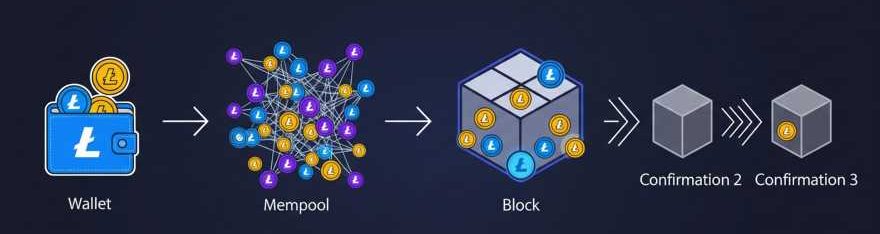
Each transaction is validated in a block roughly every 150 seconds, producing four times more blocks than Bitcoin. The shorter block time reduces congestion and keeps average fees in 2025 at fractions of a cent. An adaptive difficulty adjusts every 2,016 blocks, ensuring stable block times despite hash rate changes.
MWEB extension blocks allow confidential amounts without bloating the main chain, increasing fungibility significantly.
Good to know
- Addresses: Litecoin addresses commonly start with
Lorltc1. You can share an address publicly to receive LTC. - Confirmations: Many wallets show a payment as “pending” before it’s included in a block. More confirmations mean greater finality.
- Fees: You choose a fee in your wallet. Higher fees can confirm sooner when activity is busy; otherwise, typical fees are low.
Litecoin vs. Bitcoin: Digital Silver Meets Digital Gold
While both networks share Proof-of-Work and open-source code, their metrics differ significantly. With a four times higher max supply and a four times shorter block time, Litecoin offers higher throughput, with transaction fees in 2025 usually under $0.01, while Bitcoin averages $1–$2.
Bitcoin maintains the strongest network effect and the largest market capitalization but faces greater scaling pressure. Litecoin has often acted as a testbed for Bitcoin-compatible innovations: SegWit and MWEB were deployed here before Bitcoin considered them.
Analysts note that Litecoin’s hash rate is only about one-tenth of Bitcoin’s. Still, it processes millions of microtransactions for consumers and merchants daily.
| Feature | Litecoin (LTC) | Bitcoin (BTC) |
|---|---|---|
| Launch year | 2011 | 2009 |
| Block time (avg.) | ~2.5 minutes | ~10 minutes |
| Max supply | 84 million LTC | 21 million BTC |
| Mining algorithm | Scrypt | SHA-256 |
| Typical fees | Low for everyday transfers | Low to higher depending on demand |
| Common use cases | Payments, remittances, exchange transfers | Store of value, large settlement, payments |
Use Cases in 2025: From Payments to Gaming
By 2025, Litecoin is far more than a reserve asset. The currency serves as a payment method at tens of thousands of webshops and physical retailers using processors like BitPay, NOWPayments, or PayPal. Several Visa program cards convert balances in real time, enabling spending at POS terminals worldwide.
With high UTXO utilization and low fees, remittance services favor LTC for cross-border microtransfers to Latin America, Africa, and Southeast Asia. Developers see LTC as a testbed for Bitcoin-compatible Layer-2 ideas such as atomic swaps, package relay fees, and MWEB confidentiality. Gaming platforms also integrate LTC to exchange skins, in-game assets, and NFTs within seconds.
How to Buy and Store Litecoin Safely
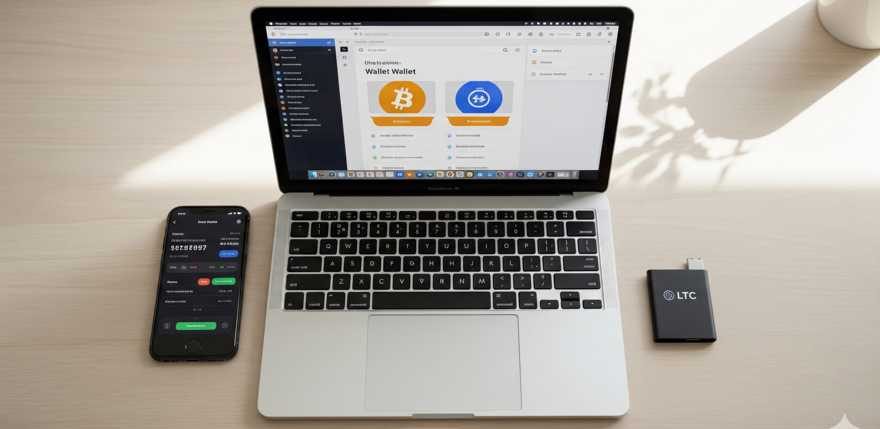
Exchanges like Coinbase, Binance, and Kraken list LTC, with purchases possible via SEPA, credit card, or P2P trading. For storage, hardware wallets such as Ledger Nano or Trezor are recommended, or mobile apps like Cake Wallet. Private keys remain in user custody, and a seed backup helps minimize risks of loss.
Mobile wallets
These are iOS and Android apps. You install, create a new wallet, and write down your recovery phrase. From there, you can receive LTC via QR code and send with a tap. Mobile wallets are convenient for daily use and for scanning QR codes in person.
Desktop wallets
Desktop applications give you a full-screen experience for managing addresses, viewing transaction history, and connecting to hardware devices. They’re useful if you prefer a keyboard and want a broader overview of activity.
Hardware wallets
Hardware devices keep your private keys in a dedicated, offline unit that signs transactions when connected to your phone or computer. They’re a popular option for people who hold larger balances and want peace of mind with physical confirmation for every send.
Set-up essentials
- Install a reputable wallet from the official site or app store.
- Create a new wallet and securely note the recovery phrase in order.
- Set a strong passcode or password within the app.
- Receive a small test amount of LTC to practice before larger transfers.
Beginner’s Checklist (Use Once, Then You’re Set)
- ☑️ Choose your wallet type (mobile, desktop, or hardware) and install it.
- ☑️ Create your wallet and write down the recovery phrase clearly and in order.
- ☑️ Enable app security (PIN, biometrics, or password) for quick access.
- ☑️ Receive a small amount of LTC to test and confirm you can see the balance.
- ☑️ Send a small test transaction to another wallet you control to learn the flow.
- ☑️ Learn how to display your address QR code and share it correctly.
- ☑️ Explore the fee slider in your wallet so you know how to prioritize speed.
Fees and Speed: What to Expect
Litecoin’s design keeps average fees low and confirmation times quick. You choose a fee in the wallet; most apps recommend an appropriate level based on current network activity. Even at busy times, fees remain competitive for everyday transfers. If you need speed, set a higher recommended fee to encourage inclusion in the next block. If you’re moving funds between your own accounts and time is flexible, standard suggested fees typically suffice.
| Scenario | Typical approach | What you’ll see |
|---|---|---|
| Everyday payment | Use wallet-recommended fee | Confirmation in a few minutes |
| Time-sensitive transfer | Choose a higher recommended fee | Higher chance of next-block inclusion (~2.5 min) |
| Slow but economical | Pick a standard or lower fee if not urgent | May take a few blocks to confirm |
Supply, Halving, and Why It Matters to You
Litecoin has a fixed maximum supply of 84 million coins. New LTC is issued as a block reward to miners, and that reward decreases over time in scheduled “halvings.” For you as a user, the key takeaway is predictability: the issuance schedule is transparent and built into the protocol. You don’t need to do anything to “opt in”; the network enforces it behind the scenes, and your wallet simply shows balances and transactions as normal.
Key numbers you can remember
- Max supply: 84,000,000 LTC.
- Average block time: ~2.5 minutes.
- Halving schedule: periodic reductions in new issuance built into the protocol.
Understanding Litecoin Addresses
When you tap “Receive,” you’ll see a string of letters and numbers or a QR code. Litecoin addresses often begin with L (legacy) or ltc1 (Bech32). Both receive LTC, but Bech32 (the one starting with ltc1) is designed to be efficient and reader-friendly. If you encounter an address that looks unusual, scanning the QR code removes guesswork and helps avoid typos.
| Address style | Looks like | Where you’ll see it |
|---|---|---|
| Legacy (P2PKH) | L... |
Older wallets, compatibility modes |
| Bech32 (SegWit) | ltc1... |
Modern wallets; efficient format |
| QR code | Square black-and-white pattern | Merchant checkouts, wallet receive screens |
Privacy Spotlight: How MWEB Works
MimbleWimble Extension Blocks (MWEB), introduced in May 2022, anchor a parallel privacy layer alongside each Litecoin block. Transaction amounts are hidden with confidential transactions, while CoinJoin logic obscures input-to-output mapping.
Users can transfer coins via opt-in peg-in, later exit without loss, and thus enjoy fungible, scalable digital cash without publicly visible balances. The approach complements transparency rather than eliminating it entirely.
Latest Litecoin News and Market Updates
In September 2025, LTC recovered to around $120, aiming at the $127–$135 range after correcting to $105 earlier in the month.
At the same time, the Litecoin Foundation announced new mobile core clients with native MWEB support at the Summit in Las Vegas, fueling privacy enthusiasm.
