How it works: thousands of nodes record BCH transactions in blocks about every 10 minutes.
Why it matters: you can move value globally with minimal friction and without bank hours.
Bitcoin Cash (BCH) was created in 2017 as a hard fork of the Bitcoin blockchain. The split stemmed from long debates about the scalability of the network. While Bitcoin increasingly came to be viewed as digital gold and a store of value, Bitcoin Cash placed its focus on being used as a medium of exchange.
The driving forces behind the fork included Roger Ver, Amaury Séchet, and companies like Bitmain. On the day of the split, all Bitcoin holders received an equivalent amount of Bitcoin Cash.
Technology and Key Differences from Bitcoin
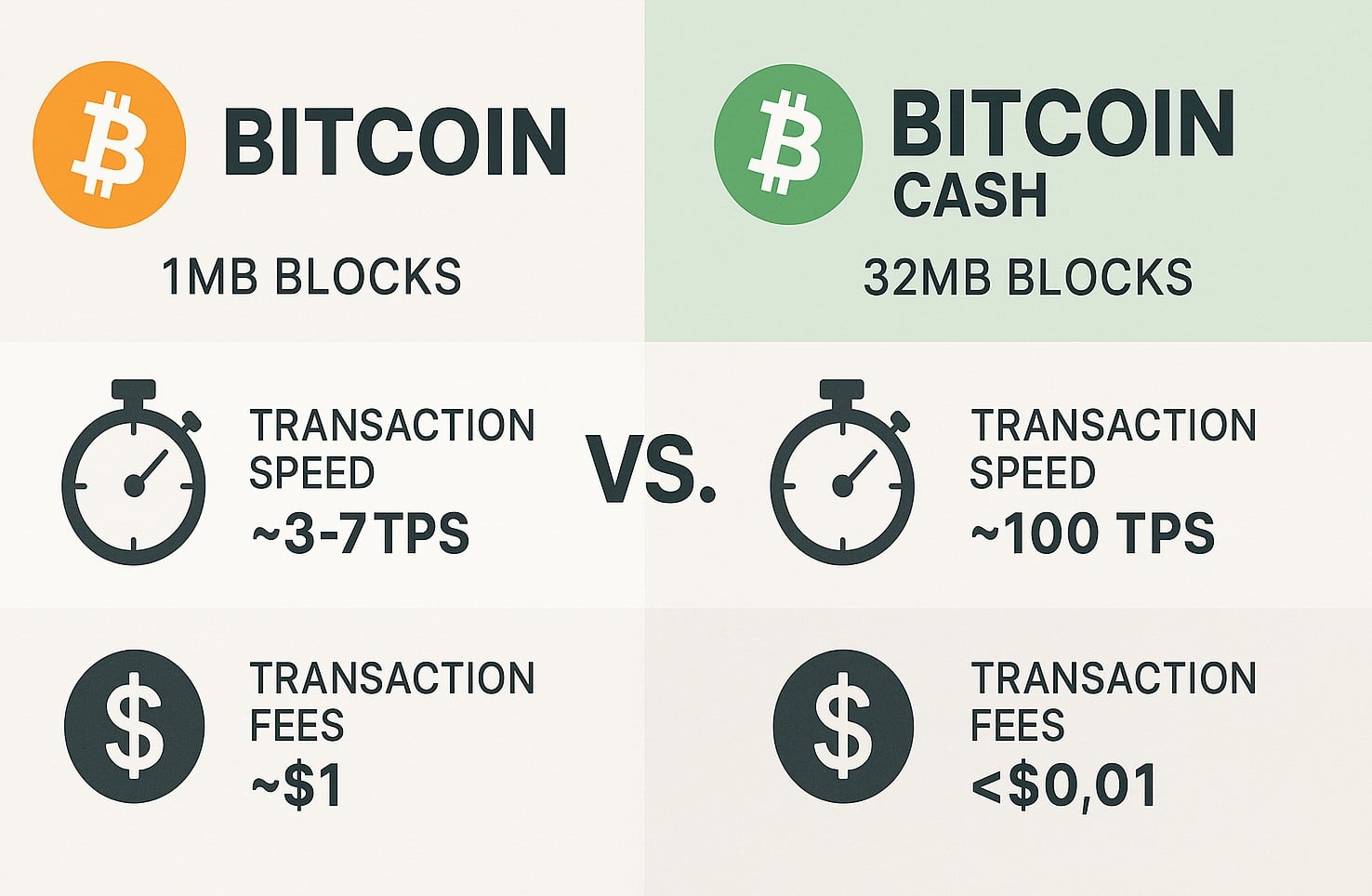
The most important difference between Bitcoin and Bitcoin Cash lies in block size. While Bitcoin uses 1 MB blocks, BCH increased block capacity to 32 MB. This allows far more transactions to be processed in less time, reducing average transaction fees to under $0.01 compared to several dollars on Bitcoin.
While Bitcoin processes around 7 transactions per second, BCH can theoretically handle over 100. In addition, since 2019, BCH has implemented Schnorr signatures to improve user privacy.
The Expanding BCH Ecosystem
The Bitcoin Cash ecosystem is now well established and widely used across many countries. BCH is supported by major wallets including Ledger, Trezor, Electron Cash, Trust Wallet, and Exodus. An increasing number of payment processors also support it, such as CoinGate, BitPay, GoCrypto, and NOWPayments.
In e-commerce, platforms like Shopify, Newegg, and Purse.io, as well as retail chains in South America and Africa, have adopted it. A unique initiative is Bitcoin Cash City in Townsville, Australia, where many local businesses and restaurants accept BCH payments directly.
Category
Examples
Wallets
Ledger, Trezor, Electron Cash, Trust Wallet, Exodus
Payment Processors
CoinGate, BitPay, GoCrypto, NOWPayments
E-Commerce Platforms
Shopify, Newegg, Purse.io
Local Initiatives
Bitcoin Cash City, Townsville (Australia)
Real-World Use Cases for Bitcoin Cash
Bitcoin Cash is primarily used for everyday transactions and cross-border payments. For micropayments, such as streaming services and gaming, fees are fractions of a cent, making BCH particularly attractive. Many NGOs also use BCH’s efficiency to deliver aid directly.
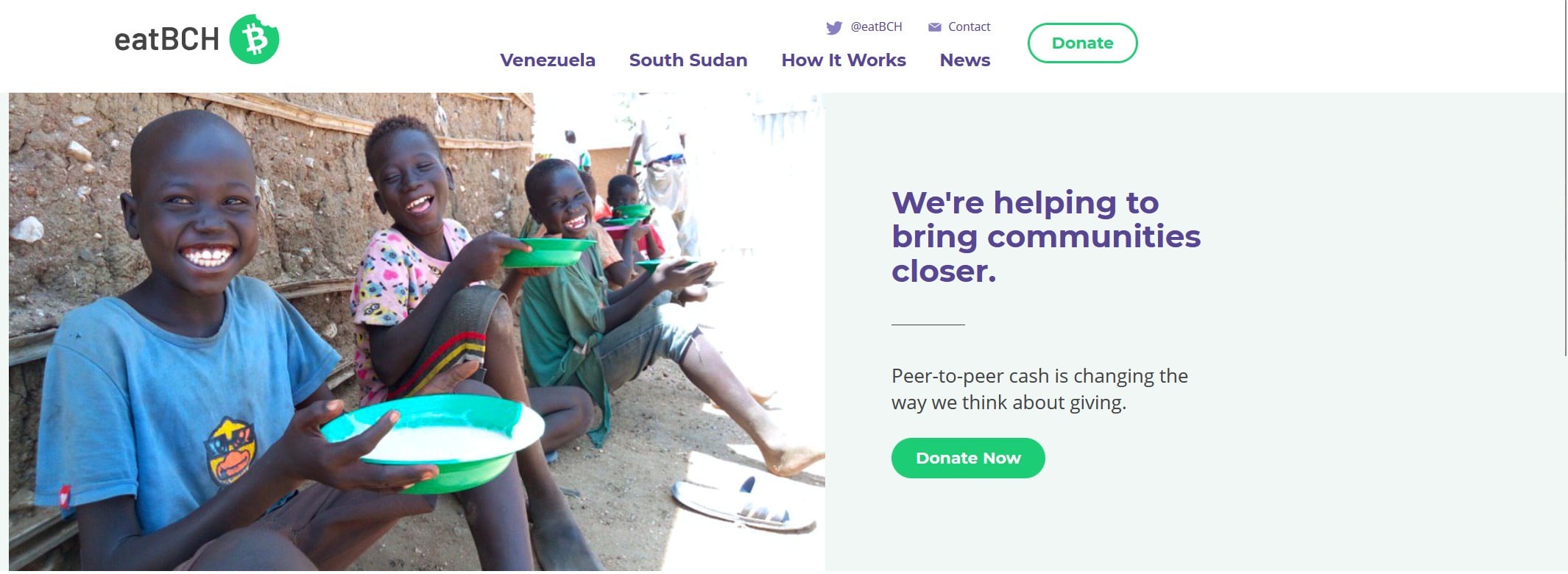
EatBCH, founded in 2018, is a well-known example: the organization relies entirely on Bitcoin Cash to provide food aid without intermediaries in regions such as Venezuela and South Sudan.
BCH Tokenomics Explained
Like Bitcoin, Bitcoin Cash has a capped supply of 21 million coins. The block reward halves every four years. Around 19.6 million BCH are currently in circulation, with block times averaging around 10 minutes. The next halving is expected in 2028. BCH emphasizes liquidity and low transaction costs to strengthen its position as “digital cash.”
Metric
Value
Max Supply
21 million BCH
Circulating Supply
≈ 19.6 million BCH
Block Time
10 minutes
Halving Cycle
Every 4 years
Next Halving
2028
Latest Developments and Future Outlook
Bitcoin Cash is gaining traction especially in emerging markets with unstable national currencies, such as Venezuela, where hyperinflation has driven merchants to accept BCH. Technical enhancements also play a vital role.
The introduction of CashTokens in 2023 brought smart contract functionality and tokenization directly to the blockchain, giving BCH even greater flexibility. Further upgrades are planned to support higher transaction volumes and broader adoption.
What is Bitcoin Cash — 10 Essential FAQs
How is Bitcoin Cash secured and who keeps it running?
Bitcoin Cash is secured by proof-of-work (PoW). Miners compete to find valid blocks using SHA-256 hash power, while a global network of nodes validates rules and relays transactions. Once miners add a block, its data becomes increasingly costly to rewrite as more blocks build on top. In practice, you benefit from open participation (anyone can run a node), economic incentives (block rewards and fees), and transparent rules enforced by software clients across the network.
What is the halving and why does it matter for BCH supply?
“Halving” is a scheduled event that cuts the block subsidy in half after a fixed number of blocks. Over time, this reduces the rate at which new BCH enters circulation, trending total supply toward the 21 million cap. For you, the takeaways are simple: new issuance declines predictably, miner rewards shift more toward fees, and the monetary schedule follows a transparent, code-defined timeline rather than discretionary decisions.
CashAddr vs. legacy addresses: what’s the difference?
Bitcoin Cash commonly uses CashAddr (e.g., bitcoincash:qq...), which adds a human-readable prefix and checksum to reduce mistakes. Legacy addresses look similar to old Bitcoin formats and can cause confusion. Practical rules:
Prefer CashAddr in wallets and invoices.
Use QR codes to avoid typos.
Most wallets can convert formats if needed.
CashAddr improves clarity and helps ensure BCH is sent to the correct network and destination.
How do you read a BCH transaction on a block explorer?
Open any reputable explorer and paste the TXID. You’ll see:
Inputs: previous outputs you’re spending.
Outputs: recipients and any change back to you.
Fee: inputs minus outputs.
Confirmations: number of blocks built after inclusion.
Many explorers also show memos, scripts, and raw data. For quick checks, focus on status (pending vs. confirmed), value (BCH and your local currency), and time (block height and timestamp).
How does Bitcoin Cash keep block times near ten minutes?
BCH targets ~10-minute blocks. To stay near that average despite changing hash power, clients use a difficulty adjustment algorithm (DAA). The DAA regularly recalibrates mining difficulty so blocks don’t arrive too fast or too slow for long. For everyday use, you don’t need to tune anything—your wallet simply benefits from predictable confirmation cadence and a network that adapts to real-world mining conditions.
What are CashTokens in practical terms?
CashTokens let developers create tokens and programmable features directly on Bitcoin Cash. You might encounter:
Fungible tokens for loyalty points or credits.
Non-fungible tokens (unique passes or items).
Contract-like logic enabling controlled transfers or gated access.
For you, this means wallets can hold BCH and app tokens together, enabling seamless payments, access, and simple automation without switching networks.
SLP vs. CashTokens: what changed?
Bitcoin Cash previously supported the Simple Ledger Protocol (SLP) for tokens. CashTokens is the newer, more integrated approach. Quick comparison:
Aspect
SLP
CashTokens
Integration
Overlay standard
Protocol-level features
Programmability
Basic
Enhanced script capabilities
Use cases
Tokens
Tokens + access & logic
How can you accept BCH on a website or app?
There are two straightforward routes:
Plugins for common storefronts (generate BCH invoices with amounts, labels, and expiries).
APIs/Webhooks to create addresses per order and mark paid after confirmation.
Implementation tips: use CashAddr, display a QR code, quote amounts in local currency at checkout, and provide a “copy address” button. Keep your order system in sync by listening for transaction seen and confirmed events.
What is Simple Payment Verification (SPV) and why do wallets use it?
SPV lets lightweight wallets verify transactions without downloading full blockchain history. Your app requests block headers and merkle proofs from peers to confirm inclusion, keeping storage and bandwidth modest. For you, that means fast startup, mobile-friendly operation, and practical security for everyday payments—while full nodes continue shouldering the heavy lifting of complete validation and archival data.
How do micro-payments and recurring payments work on BCH?
Because fees are tiny, BCH suits micro-payments like tips or pay-per-article. For recurring flows, you can generate payment requests with standard amounts and labels on a schedule, or use app logic to issue new invoices periodically. Helpful practices:
Share QR codes for one-tap repeats.
Use labels/memos so history stays organized.
Consider tokens or access passes for subscription-style perks.
This article is for informational purposes only and does not constitute investment advice.
The content does not represent a recommendation to buy, sell, or hold any securities or financial instruments. Readers should conduct their own research and consult a qualified financial advisor before making investment decisions. The information provided may not be current and could become outdated. While AI was used in the creation process, every article is meticulously edited, independently fact-checked, and ultimately approved and published by a human editor.
Read full disclaimer
Jake Simmons was the former founder and managing partner at CNF. He has been a crypto enthusiast since 2016, and since hearing about Bitcoin and blockchain technology, he has been involved with the subject every day.
Prior to Crypto News Flash, Jake studied computer science and worked for 2 years for a startup in the blockchain sector.


 All news is rigorously fact-checked and reviewed by leading blockchain experts and seasoned industry insiders.