


 All news is rigorously fact-checked and reviewed by leading blockchain experts and seasoned industry insiders.
- Solana Foundation President Lily Liu says blockchain gaming is dead and won’t come back, sparking heated debate.
- Despite the bleak prediction, gaming accounted for 25% of all Web3 activity last year, pulling in more users than DeFi, NFTs, and AI.
Gaming, one of the core applications blockchain promised to deliver, has failed to live up to the hype, and according to the President of the Solana Foundation, it’s “not coming back.”
Lily Liu shared her views on Friday, responding to a post about the shutdown of Mark Zuckerberg’s famed metaverse division at Meta, which promised to deliver the future of work, digital interactions, and gaming, but ended up sinking over $80 billion.
Also, gaming on a blockchain is not coming back https://t.co/1GDmBrGaxg
— Lily Liu (@calilyliu) March 20, 2026
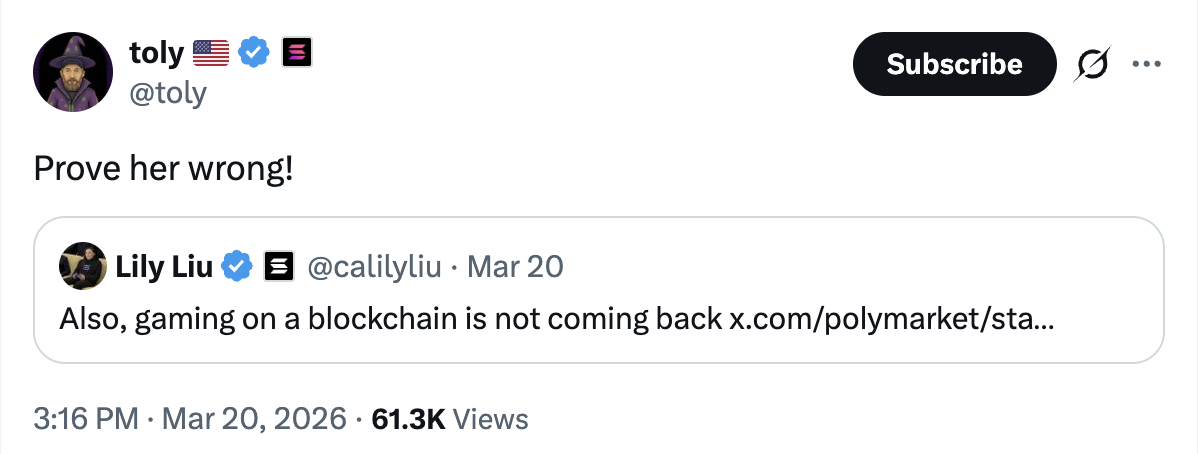
The post attracted massive interest from the Solana community and beyond, especially since Liu also heads the Solana Foundation’s gaming division. Some agreed with Liu, claiming that most games have died off or are losing players. Solana founder Anatoly Yakovenko was among those who backed Liu, adding that her post proved Solana was truly neutral and decentralized, allowing everyone to express their opinion.
Others noted that while over 1,700 blockchain games had launched in recent years and raised $4 billion, over 95% of them were dead or only had a few thousand players a month, proving the sector is dying.
“She’s right! Most web3 games were never games; they were monetization funnels disguised as gameplay. If the game only works when people believe the asset goes up, then it was never a game to begin with,” another user opined.
Some blamed the downfall on Solana. One project, Meta Financial, claims to have built a game originally on the BNB Chain before expanding to Solana. It claims that the transactions took much longer to process, and sometimes, confirmed transactions would later disappear.
“Lily Liu says gaming is not coming back. Maybe what she actually meant was, gaming never came to Solana in the first place,” the project stated.
Is Blockchain Gaming Dead?
A majority of the responses disagreed with Liu, however. One user who runs an early-stage crypto venture capital firm says blockchain is addressing challenges game developers have faced for decades, and that with tokenization, the future of gaming is upon us.
Eli Ben-Sasson, the CEO of Starkware, the company behind the Ethereum Layer-2 Starknet, also disagreed with Liu. He says that gaming has failed to work on most chains because it requires massive scaling, a paymaster, session keys, and extensive computation.
“Look for a chain that delivers all of the above, and you’ll find a very active on-chain gaming community,” he stated.
Strongly (strongly!) disagree.
Onchain gaming requires massive scale, session keys, paymaster, multi-calls, and big computation transactions.
Look for a chain that delivers all of the above, and you'll find a very active onchain gaming community.
Let me know if you need help… https://t.co/oHA9OoCnPb— Eli Ben-Sasson | Starknet.io (@EliBenSasson) March 20, 2026
The numbers prove Liu wrong. The latest State of Blockchain Gaming report from DappRadar shows that in Q3 last year (the Q4 report is yet to be published), the sector accounted for 25% of all Web3 activity, a 5% increase quarter-on-quarter. This was the largest share in the industry, ranking above DeFi (17.9%) and NFTs (18.5%).
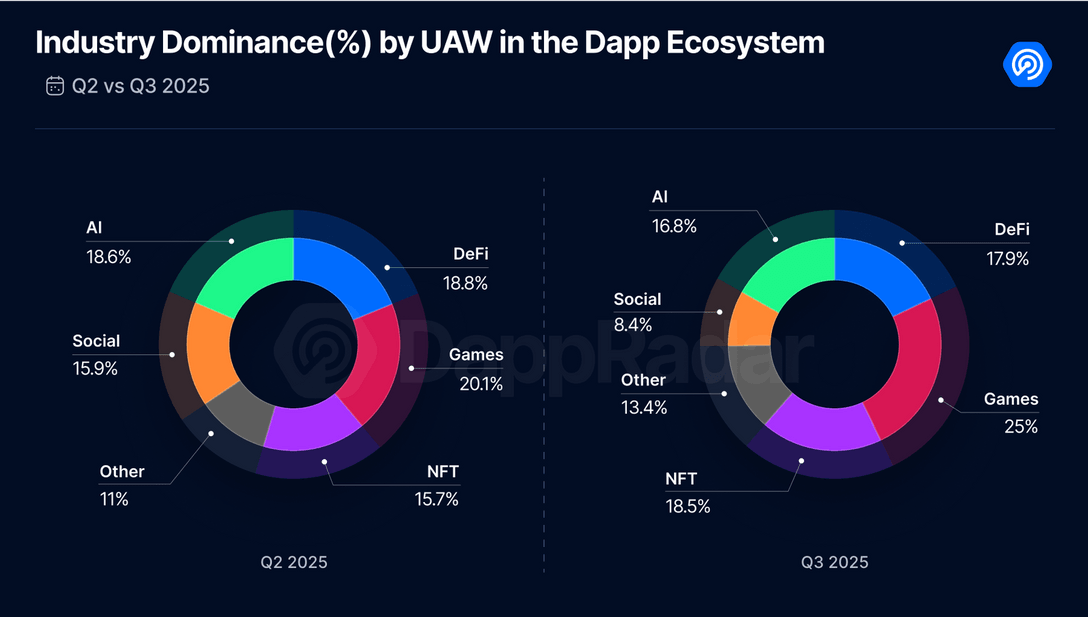
Gaming attracted 4.66 million unique daily active wallets, with some networks like opBNB attracting over a million users in Q3. The sector remains vital to the roadmaps of multiple blockchain networks, with Sui, Pi Network, Sei, and Immutable prioritizing it in recent months.
