

 All news is rigorously fact-checked and reviewed by leading blockchain experts and seasoned industry insiders.
- Polkadot set a 2.1 billion DOT supply limit and reduced annual issuance from 120 million to 55 million.
- It replaced treasury burns with the Dynamic Allocation Pool, which aggregates fees, slashes, and coretime income for governance.
On March 14, Polkadot launched a new token issuance model that sets a maximum supply of 2.1 billion DOT. The updated model slashes annual DOT issuance from 120 million to 55 million as annual inflation drops from 10% to 3.1%. More than 80% of the capped supply has already entered circulation.
OpenGov approved Referendum 1710 with about 81% support, locking in a new monetary framework for DOT. The measure followed a long community push to reduce long-term issuance. It also maintains staking incentives, treasury funding routes, and a predictable supply schedule.
Polkadot’s issuance model upgrade is scheduled to coincide with Pi Day on March 14.
This protocol change introduces, among others:
‣ A maximum supply of 2.1B DOT, of which ~80% has already been issued.
‣ A DOT emission rate reduction by ~53% on March 14, and further…— Polkadot (@Polkadot) March 13, 2026
Notably, more than 62% of DOT remains staked for network security under the current structure. That level keeps a large share of supply out of daily market activity. At the same time, the new issuance curve slows new token creation across the network.
Polkadot Issuance Schedule and Treasury Changes
Polkadot has not implemented a Bitcoin-type halving. Rather, the network proposed a progressive plan under which the remaining issuance would decrease by 13.14% every two years.
Each cut applies to the remaining mintable supply, not the total supply. Under this path, DOT inflation is expected to move below 1% in the early 2030s.
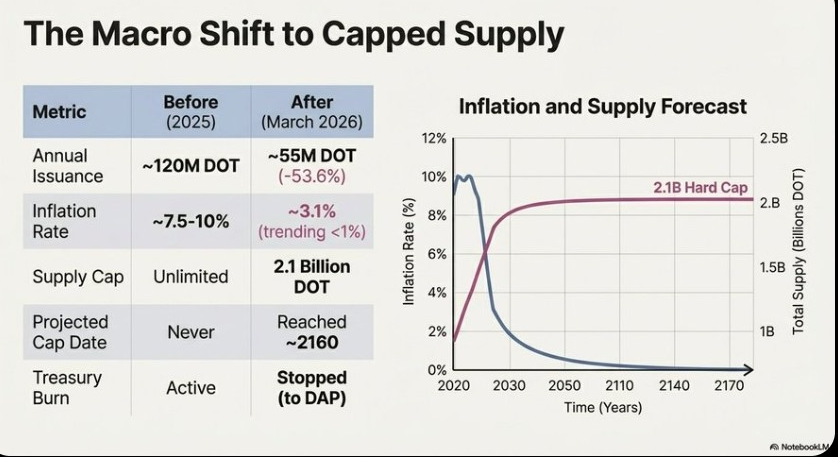
The network also ended its earlier treasury burn system and replaced it with the Dynamic Allocation Pool. Under this structure, unused value no longer gets destroyed. It now moves into a governance-controlled funding pool for future network spending.
The pool receives newly minted DOT, validator slashes, transaction fees, and revenue from coretime sales. Governance can direct those funds to validator rewards, nominator rewards, ecosystem development, treasury needs, and a strategic reserve. That reserve creates an extra funding bucket for future network priorities.
Polkadot has lined up staking changes for later in 2026. Validators will need 10,000 DOT in self-stake. A 10% minimum commission will also apply across the validator set.
Validators that do not meet the self-stake rule may face permissionless chilling from any network participant. The network is also introducing a StakingOperator proxy that lets operators run validators without controlling staker funds.
Changes for nominators are scheduled for the second quarter of 2026. Nominators will no longer face slashing tied to validator actions. The unbonding period will also fall from 28 days to 24 to 48 hours.
As we previously covered, the new model links a capped supply, lower issuance, and revised treasury flows into a single economic redesign.
Despite the proposed upgrade, the DOT price and trading volume have declined over the past 24 hours.
