


 Alle News durchlaufen eine strenge Faktenprüfung und werden von Blockchain-Experten sowie erfahrenen Brancheninsidern verfasst und redaktionell geprüft.
- With the Bitcoin halving on the horizon on 12 May, the crypto community is currently engaged in a heated debate about how the event could affect the price of BTC.
- Historically, it is likely that after the Halving there will initially be a price decline due to selling pressure from Bitcoin’s miners.
The third Bitcoin Halving is expected to take place in less than six days, on May 12, at 01:46 UTC. For many investors, the Halving means hope for a long-term increase in the price of Bitcoin, but at the same time fear of a „dump“ directly after the event. In line with the crypto-community’s motto „Buy the rumours, sell the news“, many analysts fear that after the Halving there will be a price drop.
Two new polls on Twitter have tried to capture the sentiment in the community regarding this. According to a survey conducted by „CryptoDonAlt“ with more than 12,000 participants, almost half of the people surveyed expect the Bitcoin price to drop after the reduction of the block reward. 48 percent of respondents voted that the price of BTC will decrease similar to Litecoin (LTC) and Bitcoin Cash (BCH) after their recent Halvings. 26 percent each stated that they expect Bitcoin to trade sideways or pump after the Halving.
https://twitter.com/CryptoDonAlt/status/1257476604235862016
A similar survey by TheCryptoLark, with 1,400 participants, produced a similar result. Similarly, 44% of respondents declared that the price of Bitcoin would fall, while only 14% voted for „moon time“ and a sharp increase.
#bitcoin halving is 8 days away, what are you expecting?
— Lark Davis (@TheCryptoLark) May 4, 2020
Historically, Bitcoin’s Halving is initially bearish
A look at Bitcoin’s history and previous Halvings shows that the survey participants could possibly be right. Although the Halving was bullish for the price of Bitcoin in the long term, the periods shortly after the Halving show a different picture. This is due to the Bitcoin miners, who earn fewer Bitcoin after Halving and will be partially forced to stop or reduce their operations.
As a consequence, historically, there will be larger sales of Bitcoins by miners that use older equipment and therefore can no longer mine profitably. This puts considerable selling pressure on the market, which pushes the price down in the first weeks after Halving.
This year’s Halving could also be aggravated by the fact that only yesterday, May 5th, the difficulty level recorded the second highest level ever reached. Bitcoin’s difficulty adjustment is carried out every 2016 block to balance the competition and ensure that only about 144 blocks per day are mined. The last adjustment before the Halving caused the difficulty to increase to 16.1048 T.
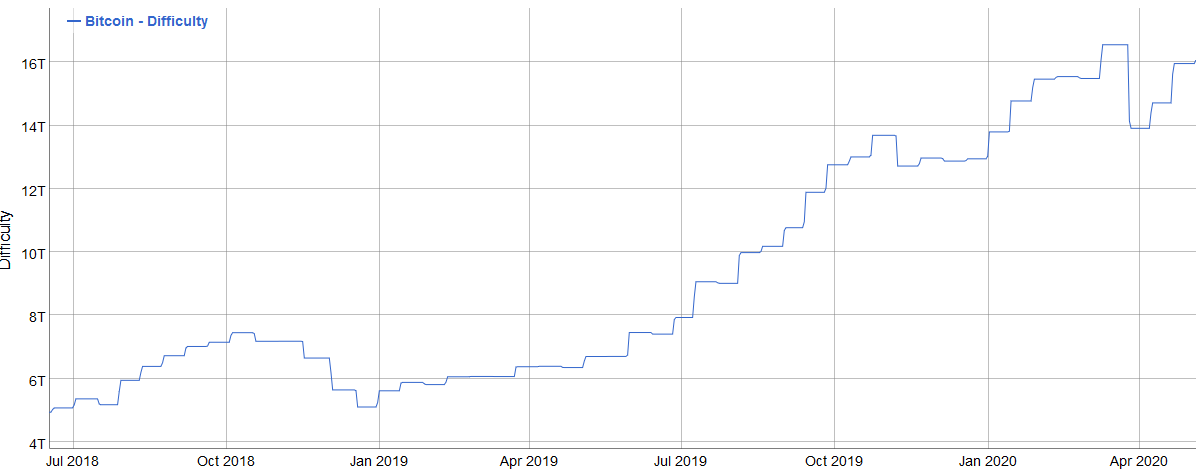
Of course, the reasons for this can only be speculated, but the increased BTC price and the fact that the miners want to collect the higher block reward before Halving will certainly play a role. The higher difficulty could, however, hit the Bitcoin miners even harder until there is a downward correction of the difficulty.
