


 All news is rigorously fact-checked and reviewed by leading blockchain experts and seasoned industry insiders.
- Bitcoin mining difficulty hits an all-time high, boosting network security and decentralization.
- Increased mining competition reflects strong long-term confidence in Bitcoin infrastructure.
Bitcoin just broke another record, but it’s not about the price. This time, it wasn’t the candlestick chart that rose, but rather the mining difficulty.
According to CoinWars, as of early August 2025, Bitcoin mining difficulty jumped to 127.62 trillion. This is the highest number in Bitcoin’s history. So, is it getting harder to find a block? Yes, and that’s not without consequences.
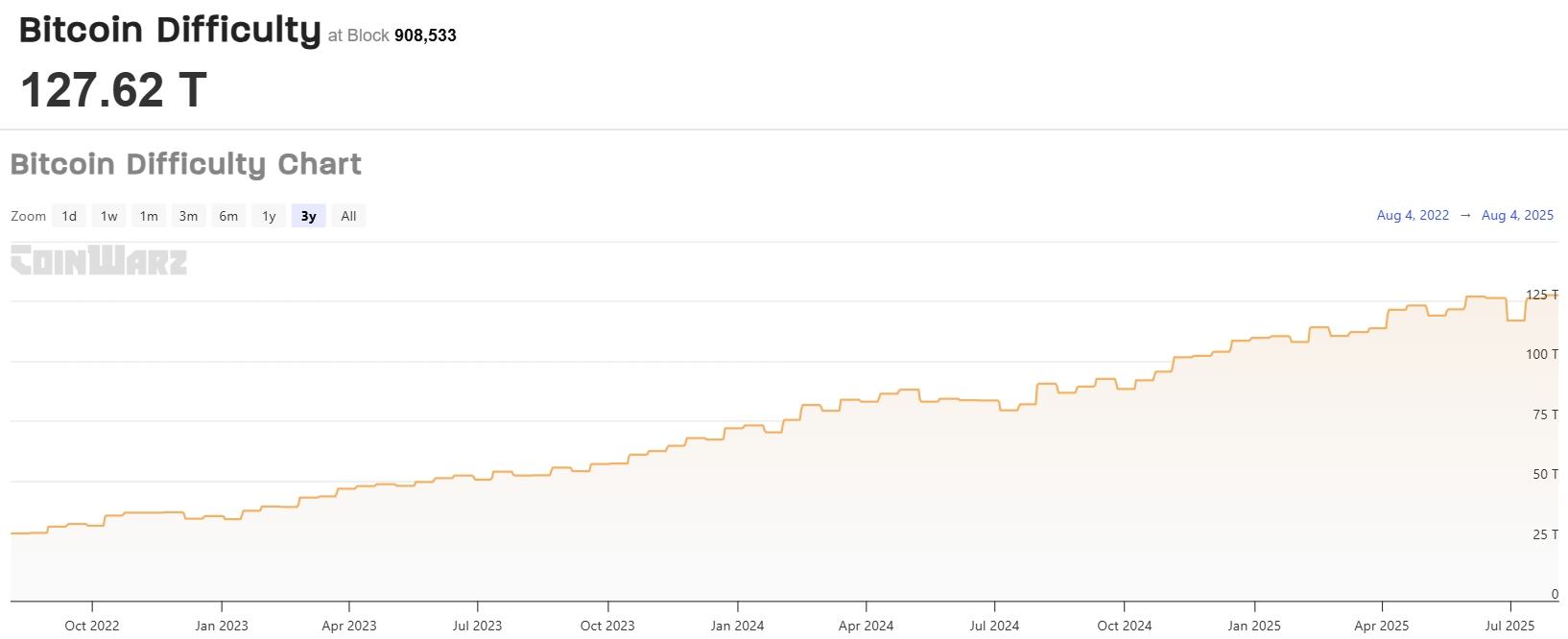
Simply put, the higher this number, the more computing power miners need to find a new block. On the other hand, this spike can also be interpreted as a signal that the Bitcoin network is getting stronger and more difficult to penetrate. If you think this is good news for security, you’re not wrong.
However, behind the good news about network security, there’s another side that’s making miners frown. Operational costs are also rising. From the increasingly sophisticated prices of ASIC devices to persistent electricity bills, all of this is reducing profit margins.
In fact, even though average daily revenue per exahash per second (EH/s) rose 4% to $57,400, it was still 43% lower than before the April 2024 halving.
Furthermore, the CNF recently highlighted total miner revenue for July 2025, which reached $1.66 billion—the highest since last year’s halving. This means that despite intensifying competition and rising costs, mining activity remains robust. This could be because major players remain optimistic and willing to burn capital.
Meanwhile, as of press time, BTC is changing hands at about $114,597.72, up 0.83% over the last 24 hours with a market cap of $2.28 trillion.
Rising Bitcoin Mining Difficulty Hints at Institutional Moves
Furthermore, this difficulty spike also usually has a behind-the-scenes story. In previous bull cycles, this often occurred after a significant price increase. This means this may not be the end, but rather the beginning of a phase of massive accumulation, particularly from institutions. However, this still requires further confirmation.
Interestingly, this high mining difficulty has the potential to drop again in the coming days. Based on network estimates, the next adjustment on August 9th will likely reduce it by around 2–3%. Why? Because the average time to find a block is currently slightly slower than the target of 10 minutes.
So, should we be worried or happy? Well, it depends. If you’re a small miner, this is definitely a new challenge. But if you’re an investor who views Bitcoin as a long-term asset, this is a sign that the network is becoming more resilient.