



 All news is rigorously fact-checked and reviewed by leading blockchain experts and seasoned industry insiders.
Table of Contents
- Origins and Background: The DAO Attack
- Technology and Key Differences to Ethereum
- Ecosystem and Real-World Applications
- Practical Use Cases of Ethereum Classic
- ETC Tokenomics Explained
- Latest Ethereum Classic News
- FAQ: Unanswered Questions About Ethereum Classic
The DAO Attack and the Birth of ETC
The story of Ethereum Classic begins in 2016 with a devastating hack on The DAO project, where approximately $50 million were stolen. To recover the lost funds, the majority of the Ethereum community voted for a Hard Fork, effectively creating the Ethereum (ETH) we know today. A minority, however, rejected the rollback, insisting on immutability. They continued the original chain, which has since been known as Ethereum Classic (ETC).
Technology and Key Differences to Ethereum
While Ethereum transitioned to Proof of Stake (PoS), Ethereum Classic continues to rely on Proof of Work (PoW). Both support Smart Contracts, but there are critical differences:
| Feature | Ethereum (ETH) | Ethereum Classic (ETC) |
|---|---|---|
| Consensus Mechanism | Proof of Stake | Proof of Work |
| Smart Contracts | Yes | Yes |
| DeFi Ecosystem | Highly active, many dApps | Smaller, focused on stability |
| Mining | No longer supported | Still supported, attractive for miners |
Ecosystem and Real-World Applications
Ethereum Classic is maintained by a smaller but dedicated developer community. It enables Smart Contracts, decentralized apps, and tokenization. While the project count is smaller than Ethereum’s, ETC emphasizes technical robustness and long-term security.
ETC is supported worldwide by major exchanges and wallets, including Binance, Coinbase, and Ledger, ensuring broad accessibility for both users and developers.
What Can You Do on Ethereum Classic?
Payments and Transfers
You can use ETC for straightforward value transfer. Wallets render a clear summary—recipient, amount, and fee—before you approve. Confirmations arrive as blocks are added; your wallet usually displays the current count and a link to a block explorer for verification.
Smart-Contract Use Cases
Popular contract patterns include tokenization, escrow, and automated payout logic. Because ETC is EVM-compatible, many familiar ERC-style interfaces function similarly, letting you integrate with tooling and libraries you already know. For consumer flows, you often wrap complex calls in a single “one-click” transaction with pre-filled parameters in the dApp UI.
Costs, Confirmations, and Explorers
Estimating Gas
Your wallet suggests a gas price based on current network conditions. Complex contract calls cost more than a simple transfer. If speed matters, you can opt for a higher gas price; if you’re not in a hurry, default suggestions typically suffice.
Confirmations and Receipts
After submitting a transaction, you receive a hash. Paste it into a block explorer to see status, block number, gas used, and decoded logs. When your wallet shows the desired confirmation count, you can treat the transaction as settled for your use case.
Explorer checklist (single list):
- Locate the transaction hash in your wallet’s history.
- Open a block explorer and paste the hash.
- Confirm status (Success) and block number.
- Review gas used and fee.
- Check logs/events for contract-level outcomes.
- Share the explorer link for auditability.
Security and Key Management Essentials
Private Keys and Seed Phrases
Your wallet derives addresses from a seed phrase (a set of words). Anyone with that phrase can control your ETC. Store it offline, and never enter it into websites that claim to “recover” funds for you. For additional protection, some wallets support passphrases and address-labeling to reduce mistakes when sending.
Transaction Approvals
When a dApp requests permission to spend tokens or call a contract, your wallet shows a preview. Read the function name, parameters, and the contract address. If the wallet offers per-transaction spending caps or “only once” approvals, choose the option that fits your intended usage pattern.
Mining, Nodes, and Participation
Running a Node
Running a full node lets you verify the chain directly and broadcast transactions without relying on third-party endpoints. You’ll maintain storage for the blockchain data, keep the client updated, and monitor connectivity. Developers often run nodes to gain reliable logs and faster local queries.
Mining Overview
Miners invest in hardware and electricity to compete for block rewards. If you’re exploring the mining landscape from a learning perspective, start by reading client documentation, reviewing hardware requirements, and experimenting in a controlled environment before scaling up.
Hands-On: Your First Contract Deployment (Conceptual)
Step-By-Step Overview
Here’s a simple path you can follow conceptually to understand the flow, even before you write production code:
- Open Remix IDE in your browser and paste a minimal Solidity contract (e.g., a counter).
- Select the correct compiler version and compile until you see no errors.
- Switch Remix to an Ethereum Classic RPC (or a compatible test endpoint if available).
- Fund your deployer address with a small amount of ETC for gas.
- Click “Deploy,” approve in your wallet, then watch the explorer for confirmations.
- Use the contract’s UI in Remix to increment/decrement and read state.
Common Interfaces and Patterns
Tokens and Allowances
Token contracts expose standardized methods to query balances and transfer units. Many dApps first ask for an “approve” transaction so the contract can transfer tokens on your behalf within a defined allowance. Your wallet usually indicates which contract is being approved and for how much.
Oracles and Off-Chain Data
Smart contracts on Ethereum Classic can react to external data by consuming oracle feeds published on-chain. Architecturally, you listen for updates from a trusted data source and write logic that triggers when new values arrive, such as price updates or timestamps.
Troubleshooting the Basics
Why a Transaction Might Be Pending
If your transaction sits pending, the usual cause is an underpriced gas setting relative to peers or temporary network congestion. You can often speed things up by choosing a higher gas price in your wallet’s “speed up” feature. If needed, cancel the pending transaction by submitting a replacement with the same nonce and zero value to yourself at a higher gas price.
Decoding Contract Errors
When a call fails, your explorer may show a revert reason. Simple issues include hitting a require() check or passing parameters in the wrong order. Re-read the contract’s function signature, confirm the target address, and check whether you have the allowance or balance the function expects.
ETC Tokenomics: Understanding the Ethereum Classic Coin
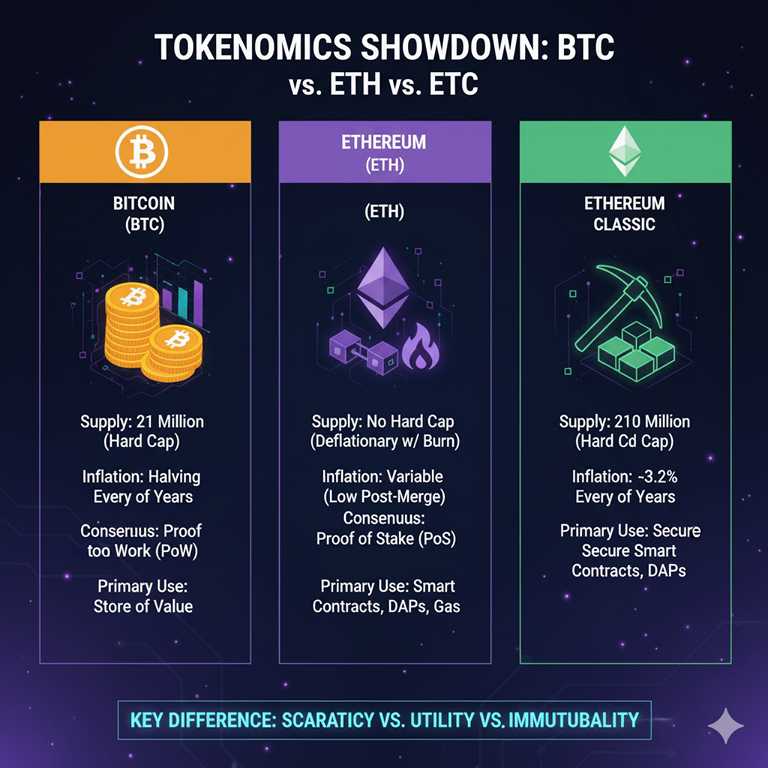
The native currency of Ethereum Classic is ETC. Similar to Bitcoin, its maximum supply is capped—at 210 million ETC. This scarcity model is designed to maintain long-term value stability.
Block rewards decrease over time, gradually reducing inflation. ETC is used as:
- Transaction fees within the network
- Smart Contract execution payments
- A store of value for long-term holders
| Metric | Value |
|---|---|
| Maximum Supply | 210 Million ETC |
| Current Consensus | Proof of Work (PoW) |
| Primary Use Cases | Payments, Smart Contracts, Mining |
Latest Ethereum Classic Developments
Ethereum Classic has faced multiple 51% attacks in the past, raising concerns over network security. These events triggered discussions around potential upgrades, including enhanced consensus mechanisms and security protocols.
After Ethereum’s switch to Proof of Stake, many miners migrated to Ethereum Classic, increasing its network adoption and strengthening its security landscape.
