



 All news is rigorously fact-checked and reviewed by leading blockchain experts and seasoned industry insiders.
- Balancer Labs is being shut down five months after an exploit on its DeFi network that drained over $100 million across multiple blockchains.
- The protocol is unaffected by the shutdown and will continue to exist, run via the DAO, the Foundation and other external service providers.
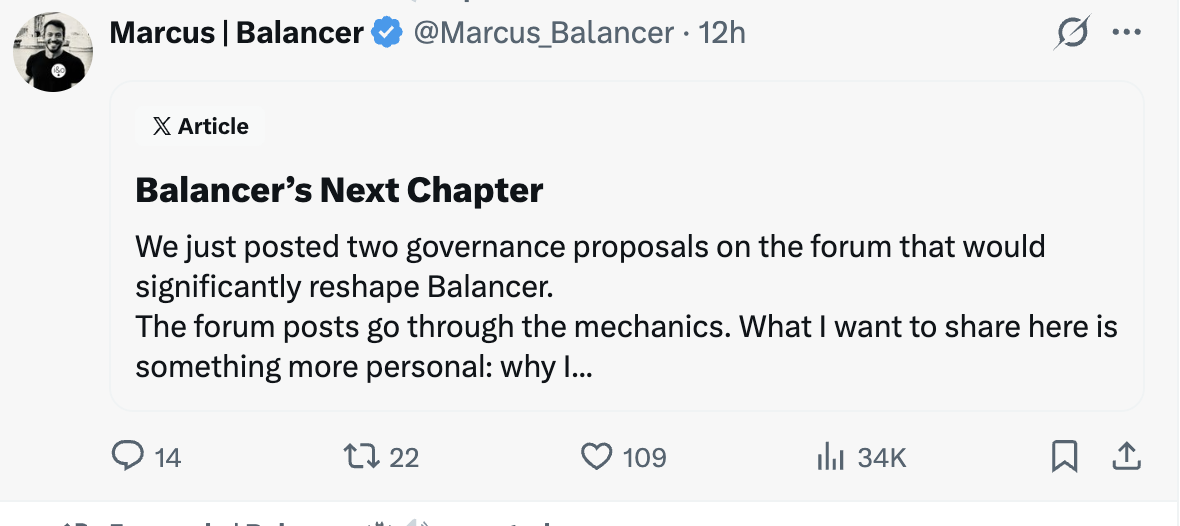
Balancer Labs, the company behind the Balancer decentralized exchange, has announced that it’s shutting down, citing rising legal risks, high costs, and weak value capture.
Announcing the shutdown, founder Fernando Martinelli said that the company has become a liability, rather than an asset, to the protocol’s future.
The main reason for the shutdown is the November exploit, in which the attacker exploited a rounding error in the protocol’s math logic and conducted several repeated swaps that kept extracting value. The protocol lost over $110 million, as CNF reported, most of it from V2 stable pools. This attack created ongoing legal exposure for the company, Martinelli says, adding:
Maintaining a corporate entity that carries the liability of past security incidents, while the protocol itself needs to move forward unburdened, is not responsible stewardship.
While the company will shut down, the protocol will continue operating unaffected. Martinelli noted that while the Labs was once critical to the protocol’s operations, it has evolved into a decentralized ecosystem where the DAO, the Foundation, and external service providers can keep the network running.
Balancer Founder Proposes New Operating Model
Balancer was once one of the main decentralized exchanges in the market. At its peak in 2021, it had over $3.5 billion in total value locked and was competing with Aave and Uniswap for market supremacy. The protocol has since fallen behind its peers; DeFiLlama data shows its TVL at $157 million, way off Aave’s $25 billion.
As the Labs shuts down, its members will transition to a DAO-aligned operating company, pending a governance vote.
Martinelli says he decided against a full shutdown of the protocol because it’s still generating real revenue. In the past three months, it generated over $1 million in annualized fees. This proves that Balancer works, but it’s being pulled down by “a broken tokenomics model and an overweight cost structure.”
To revive the protocol, the founder proposed a new tokenomics structure that ends BAL emissions, which he says have been diluting holders with no sizable benefit.
” Cutting emissions to zero is the single most important thing we can do for the token and the treasury,” Martinelli says.
He also proposed winding down veBAL, the vote-escrowed BAL that users get by locking their tokens for a period of time, in turn getting voting power on the protocol. Martinelli says that platforms that were built on top of Balancer and locked these tokens for users now control governance.
He also proposed a BAL buyback, which would be funded by the Treasury and would purchase the tokens at a premium and then burn them. This gives holders an exit opportunity while also reducing the supply.
BAL trades at $0.1547 for a $10.7 million market cap. In the past year, it has lost 90% of its value. Its all-time high price stands at $74.7, achieved in 2021.
