


 All news is rigorously fact-checked and reviewed by leading blockchain experts and seasoned industry insiders.
- Vitalik Buterin is backing the Fast Confirmation Rule, a new mechanism that would cut the time it takes to transfer funds from Ethereum from minutes to 13 seconds.
- The rule would make L2 deposits, bridges and exchange deposits much faster without sacrificing security.
Vitalik Buterin has backed a new proposal to cut the time it takes to send funds on Ethereum from minutes to seconds, in his quest to make the network easier to use, faster, and more efficient.
The proposal was published by Julian Ma, a researcher at the Ethereum Foundation. It introduces the Fast Confirmation Rule, which would reduce the deposit time from Ethereum’s base layer to Layer 2s, exchanges or bridges to a maximum of 13 seconds, reducing this wait time by up to 95%. Ma says FCR will be rolled out over the coming months and that once a client implements it, nodes can run it automatically without the need for a hard fork.
A new fast confirmation rule mechanism lets you get a hard guarantee that Ethereum will not revert after one slot (12 seconds)
Security assumptions are (i) supermajority honest, (ii) network latency under ~3s. So one step below economic finality, but very strong for many use…
— vitalik.eth (@VitalikButerin) March 18, 2026
According to Ma, the parties that will benefit most are exchanges, L2s, bridges and solvers and RPCs. Under the current system, sending funds from Ethereum can take up to five minutes, resulting in billions of dollars in capital locked up in bridges. The setup has also forced users to select trusted bridges, which are faster, over non-minting bridges that give them the strongest rights over their assets, but are slower.
“Asset issuers should not have to choose between their assets flowing across chains and leveraging Ethereum’s strong property rights,” Ma says.
FCR Makes Ethereum Faster Without Sacrificing Security
Under FCR, when a transaction is included in a block and a validator attests to the block, it will be confirmed immediately. Previously, the transaction could only be confirmed after more blocks were added or it achieved full finality. FCR will use the same guarantee that underpins the assumption of finality for confirmed blocks.
One key difference is that while fast-confirmed blocks assume that no single adversary can control 33% of the stake, FCR uses a 25% threshold. In cases where the network is slow, FCR transactions will take slightly longer, and if FCR fails, the system will just default to the existing finality setup.
In the unlikely scenario that an adversary has a 25% stake, a fast-confirmed block can be reorged. However, at current prices, a 25% stake amounts to $20.8 billion, making it economically enviable.
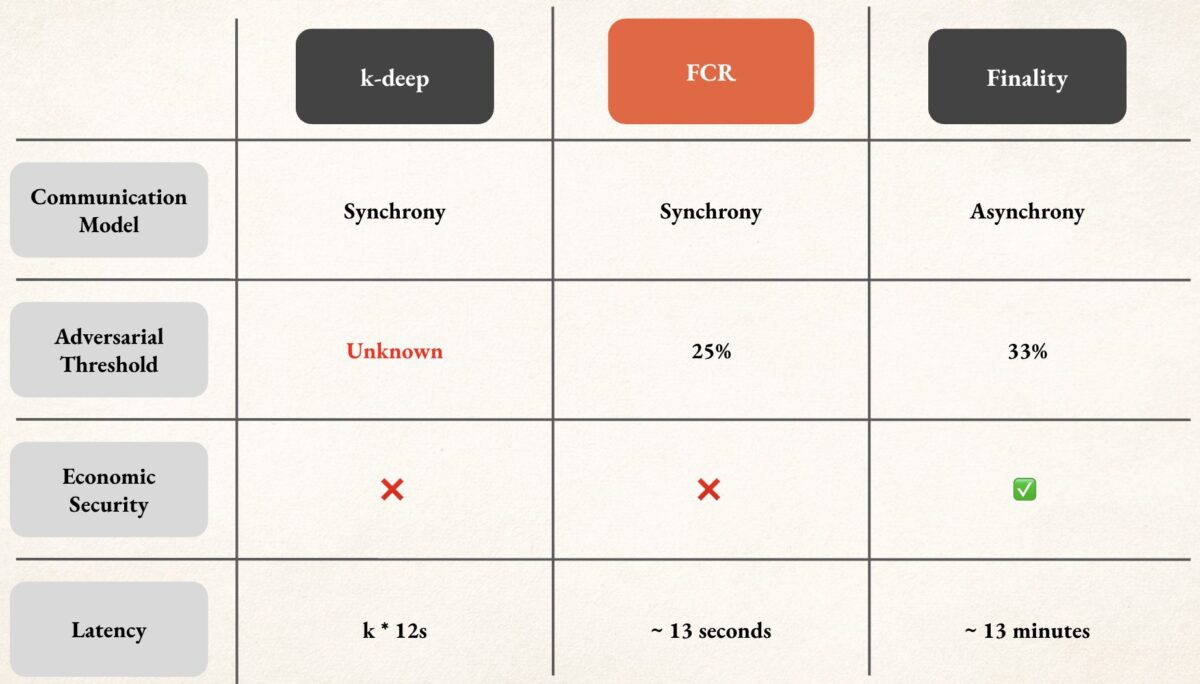
Vitalik says that FCR is “one step below economic finality, but very strong for many use cases.”
The proposal aligns with the recently published mandate by the Ethereum Foundation that prioritizes privacy, security, open-source development and resistance to centralized controls. As CNF reported, Vitalik said that Ethereum will remain a “sanctuary technology” that’s accessible even when its rivals fold.
ETH trades at $2,200, dipping 6% over the past day for a $265.3 billion market cap.